Wednesday, May 25, 2016

Lincoln Birthplace


May 22, 2016

Lincoln’s Birthplace
This National Historic Park is near the small town of Hodgensville, Kentucky.  We watched the movie at the visitor’s center, which only lasted 12 minutes.  Yet it contained information that we had not known before.  Lincoln, who was born on February 12, 1918, had only a total of two years of formal education during his entire youth.  But he had a strong interest in writing.  Though materials were scarce and expensive, he would write in any place he could find:  with his finger in the dust on the window, with sticks in the snow in the winter and the dirt on the ground in the summer.  

Lincoln’s father, Thomas, was a great storyteller.  Abraham would listen intently to his father so that he could repeat the tales to all of his friends.  This helped him to develop a talent for speaking before crowds and using language that his listeners could understand. Thomas was a farmer during Abraham’s younger years and though he was only about six years old, he helped his father work on the farm.  He would plant pumpkin seeds in between the rows of corn.   

The Lincoln family was forced to move two different times during Abraham’s younger years, because there was a dispute over ownership of the property on which they lived. (along with nine other neighbors) Thomas contested the claim made by others, but lost his fight to retain the property each time.  After the second dispute, he moved his family to what is now the state on Indiana.  Back then, it was frontier land that was undeveloped.
Can you imagine having to leave your home, friends and livelihood and start all over again not just once, but twice? 

A large marble and granite Memorial has been built on the property.  It houses a log cabin similar to the one in which the Lincoln family lives.  It was a one room structure about 18 by 16 feet with a dirt floor, one window and a single fireplace.  It is so very encouraging to realize that someone could come from such humble surroundings and also become the leader of a great nation.

Tuesday, May 24, 2016

May 24


Sorry to be so long in writing, but we have not had internet access in the mountains for several days.

May 18, 2016
Last night we drove to Oak Ridge, Tennessee, just west of Knoxville.
When we went into the museum this morning to sign up for the bus tour, we were told that there were no more seats available, but we would be the first two on the waiting list.  Most people register on line, so there was a possibility we could get on.  Since we had an hour and a half before the tour began, we went back to the r/v to eat breakfast.
Returning at 11 o’clock, we had to wait 20 more minutes to learn that 3 people did not show.   

At the first site on the tour, we saw a film that gave a history of the Manhattan Project including the purchase of land, construction of the city and the facilities where the atomic bomb was created.  “The mission in Oak Ridge was production of the uranium isotope
U-235 by three different methods-gaseous diffusion, electromagnetic separation and thermal diffusion-for a bomb.”  The project began in 1942 and the first atomic bomb was dropped on Hiroshima, Japan on August 6, 1945.  For some reason, the actual bomb was named “Little Boy”.     

The second stop on the tour was the small church which held services for different denominations at different times.  The guide said there was actually a person who participated in the war of 1812 who was buried in the cemetery adjacent to the church.  Next we proceeded to the Y-12 building, where the electromagnetic separation of uranium occurred.  (It is no longer in use.)  The last two sites we drove by: X-10, where the Graphite Reactor was built, then K-25, where gaseous and thermal diffusion processes occurred. 

One of our unexpected sites, upon leaving Oak Ridge, was a small flock of wild turkeys.  This was our first of several sightings over the next few days.  What fun it is to see these birds walking along the highway, so free and unencumbered.

Thursday May 19, 2016

We went to the Stone River National Battlefield Visitor’s Center.  The volunteer on duty gave us a brief overview of the battle, explaining that there were several times when the victory could have gone to the Confederacy.  But the Union won out in the end. 

There are several large artillery guns on display through out the park.  We learned that there were even more soldiers in this battle than at Chickamauga.  Over 23,000 died in that campaign.  The cemetery is a silent reminder of the huge loses to both sides of the conflict. 

 
After lunch Roger drove South about 50 miles to transmit on a section of Natchez Trace Pkwy.  just south of Nashville and E. of Murfreesboro.  After a couple of hours, we headed north again.

Friday, May 20, 2016
We had another fun, unexpected event.  We received a call from a couple whom we have maintained contact with since Roger was in the Army in the 1970s.  Joe and Maureen called and told us they were headed west to see their son and could we meet them at Mammoth Cave.  We told them that was great.  It was a perfect day to go caving, as it had been raining since yesterday.  Cell phone coverage was terrible in the mountains, but we finally connected and met them for the cave tour. 

Our guide explained that this is the largest cave in the world.  They have excavated 400 miles of tunnels, thus far.  But volunteers continue to search unexplored tunnels, adding to the length of the cave’s structure. What is so extraordinary is that these tunnels are located in an area of only 7 cubic miles.    At first this confused me.  Then the ranger gave me and example of a large city, like Nashville.  It has hundreds of miles of roads with in only a few square miles of land.  The cave’s miles are measured up and down at different levels, as well as linearly. 

There have been 27 entrances of various sizes that have been discovered so far.  The part of the cave that we toured was mostly dry and a constant temperature of 54 degrees.  But because of the rain, it was obvious where there where openings, as the water flowed freely through the few holes in the ceiling. 

Tuesday, May 17, 2016

May 16 and 17


Monday, May 16, 2016

Little River Canyon National Preserve is an 11 mile scenic drive with a 45 ft. high waterfall.  Though the water level is low right now, winter rains allow expert “whitewater paddlers (to) test their skills in the rapids”.  We enjoyed walking on the huge rocks that had long flat “steps”, making it easy to climb.  It was so good to discover such a beautiful area so close to home.


In the afternoon, we traveled to Russell Cave National Monument.  This site has been excavated by both the Smithsonian and National Geographic archeologist.  Cane baskets and stone mortar and pestle were found that document that the cave has been inhabited for 10,000 years.  How amazing is that!

After checking with the park Ranger, we parked just outside the park gate for the night.  Roger transmitted there for a couple of hours .  Before we went to bed we went outside to take down the antenna and were happily surprised to see lightning bugs flying around the sky.  We smiled as we each remembered catching them when we were children, putting them in jars to better enjoy their light.


Tuesday May 17, 2016

Today we drove to the Chickamauga and Chattanooga National Military Park, just south of the Tennessee/Georgia state line.  It is the first Military Park established by the US Congress and honors the lives of both the Union and Confederate soldiers who fought in this Civil War battle.  It is considered the campaign that was the “Death Knell of the Confederacy”.


The park has numerous monuments to individual military battalions, of both the north and south.  The movie in the visitor’s center was very impressive, as it depicted actual people with quotes from letters of soldiers who were actually on the battlefield.  The number of lost lives was so phenomenal that it is hard to believe.  But I try to find the positive in their sacrifice.  Our county survived the huge conflict of the Civil War.  It might have destroyed the nation, but people struggled to rebuild.  The United States has gone forward and continues to prosper.        


Saturday, May 14, 2016

5-13-16


5-13-  5-14

This morning we traveled to Horseshoe Bend, a National Military Park.   It is the site of one of the important battles between the US 39th Infantry and the Upper Creek Indians in 1814.  I find it hard to believe that is has only been 200 years since this area was part of the frontier.  There was a feeling of sadness when I read of the split of the Creek Indian Nation.  Half of the Indians wanted to embrace the more modern ways of the Americans, while the other half tried to maintain their prior way of life by “driving the white man” from the lands that had previously belonged to them.

The battle was named after the shape of the Tallapoosa River where the fighting occurred.  The river makes a nearly perfect horseshoe.  One of interesting things we learned was that the city of Montgomery was named after Major Lemuel Montgomery, who died in this battle and the age of only 28.  Before joining the military he had been an accomplished lawyer in Nashville, Tennessee.

5-14-16
We located the Trail of Tears National Historical Trail site in Ft. Payne, Alabama.  There are multiple sites throughout the US, where various Indian Nations were forced to leave their homelands and travel west to reservations.  This particular site was the only one originating in the state of Alabama.  In the fall of 1838, 1100 Cherokee men, women and children began the 800 mile journey.  John Benge, one of the Cherokee leaders state that “at least 2/3 (of the Indians) are in destitute condition and in want of shoes, clothing and blankets”.  What a devastating and cruel part of our country’s history.


Friday, May 13, 2016

May 11-12


5-11 & 12-16

After Roger transmitted from Tuskegee Institute and Tuskegee Airman National Park sites, we drove to Lake Martin.  This is our first time at this campground.  Since it was almost 8 pm when we backed into our campsite, we fixed dinner and went to bed.  The next morning we woke to see that we had selected a beautiful site on the lake.  After breakfast we rode our bikes around the campground.  It is one of the prettiest we have ever seen and it is huge!  There are over 600 sites scattered across six peninsulas so it doesn’t seem crowded.

There are separate picnic areas for day use and a “silo” at the end of one of the points which has an observation area that looks out over the lake.  With a fishing pier and a marina that rents various sized boats, it’s a great place for multiple types of recreation.  There are even a few cabins for those people who love nature but don’t have personal rv’s.  We are certainly glad we found it before the summer season is in full swing. 

Tuesday, May 10, 2016

On THE ROAD AGAIN


5-8-16

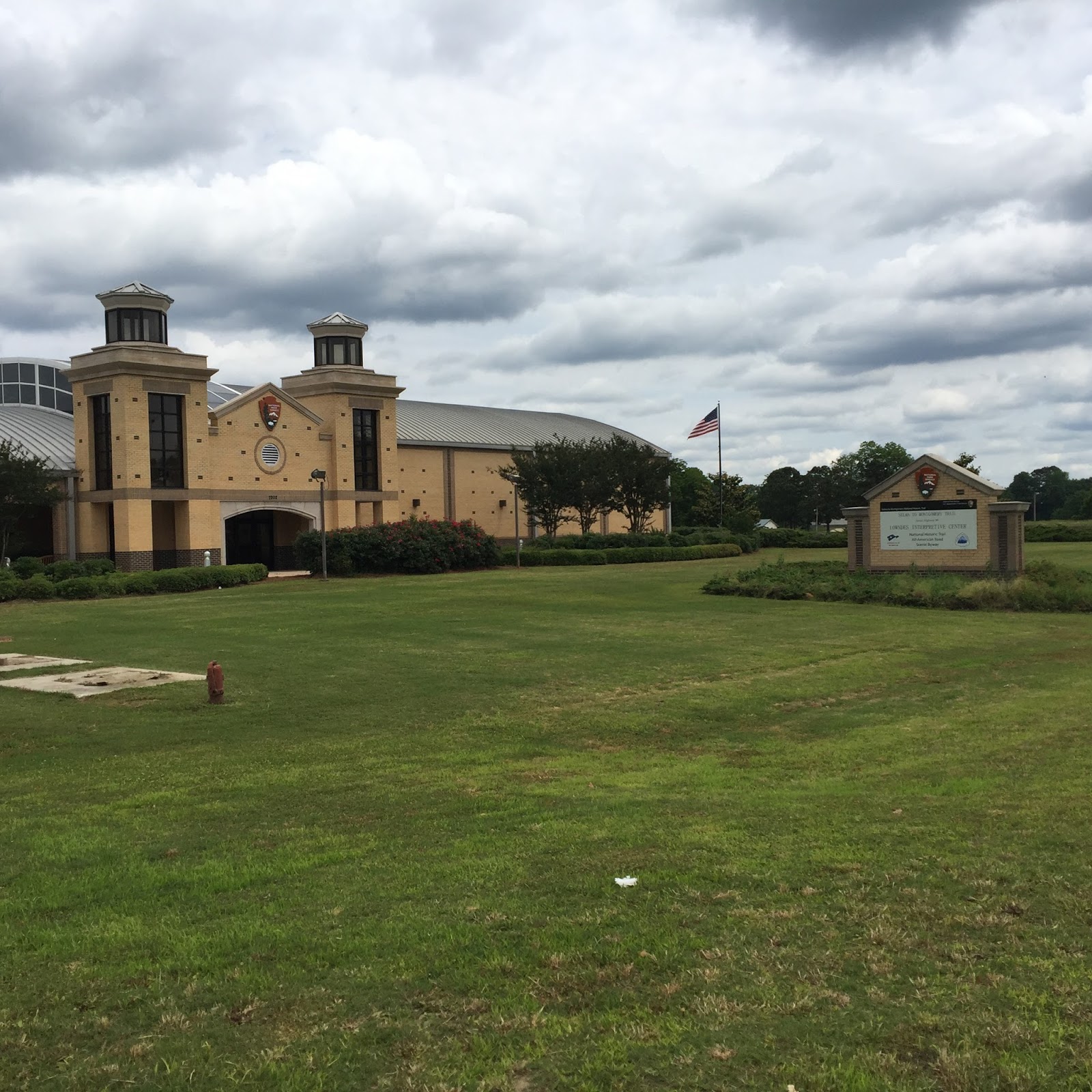
Roger and I were able to get away about 10 am on Sunday morning.  We traveled north to the first National Park site where Roger transmitted:  Selma Interpretive Center.  It documents the civil and voting rights history of black Americans and tells the story of the famous 50 mile walk from Selma to Montgomery Alabama.

After “activating” the park site for a couple of hours, we drove to our favorite campground, Prairie Creek.  ( Activating, means Roger transmits on his ham radio and acknowledges talking with other ham radio operators who are “collecting”  contacts at the various National Parks.  This is a program sponsored by the National Amateur Radio League this year, because it is the 100th anniversary of the National Park system.)
 
The campground is situated on the Alabama River between Selma and Montgomery.  Our campsite is beautiful.  It provides a 270 degree view of the river and is so peaceful:  just what we needed right now.  We spent the rest of the day relaxing and enjoying the gentle breeze and the drifting water as it sparkled in the sunlight.

Yesterday, we went for a ride on our bikes.  Roger said we would be going only about a mile.  A couple of hours later, we returned, worn out, but not discouraged.  Roger checked the map program on the computer and discovered we had ridden at total of 17 miles.  That was a new maximum for us.  So at least we know we could do it again if we had to. (but DON’T plan to).  

Friday, April 1, 2016

New Direction

Well since the Super Loop is just a dream we have to move on to something else. Our land yacht.  RV'ing is MaryJo's thing and we have been doing it now for 17 years.  We started with renting a 21ft class C in New Zealand. That's all it took to convince me that was a good life style. 

We bought an old 1978 33 ft Travco.  In its day it was the top of the line.  You still cant find features  that that RV had.  We have now been through about 5.  All of which we vowed would be our last.  Does not this sound like a boaters experience?  Our friends Jim and Gayle Cummings have a 30' Lazy Daze and we liked that. We keep down sizing and are now in 24.1 Thor AXIS.  It has a perfect layout for us.  Going from even a 30ft to the 24 made handling much easier for MaryJo. 

Other than the SuperLoop, about the last thing on my bucket list was to catch a sailfish.  So we went to Costa Rica in January and I got my fish.
 
Now MaryJo's bucket trip has been to rv the Lewis & Clark trail.  We keep putting it off and decided enough is enough and come hell or high water we are hitting the road on March 1. 
 
Well MaryJo and I graduated from Catholic High in 1966(High school sweet hearts) As such we have always been the one to get the ball rolling on the class reunions.  We got a committee going, had a couple of meetings and set a date of May 7 for the big 50 year event.  I figured we could travel some and fly or drive back for the reunion.  We have great classmates that are doing 99% of the work but I just couldn't hit the road with that on my mind so will leave the day after the event.
 
 
Actually, I also needed the time to get the new rv set up with my amateur radio equipment.   This happens to be the 100th Anniversary of the National Park Service.  Ham radio operators are always looking for an excuse to get on the air so to celebrate amateurs are encouraged to setup portable and operate from the various parks.  Each park has a federal designator.  The idea is to activate as many parks as possible with as many contacts as possible.  A contact consist of operating form the park and passing on a signal report to as many other amateurs as possible.  So there are two categories activators and chasers (those that try and talk to as many parks as possible.)   You can do both but since we are going to be traveling, I figured that it would be fun hit some of the parks and operate my station form them.  It is fun to be the station everyone is trying to call.  We just made a short shake down trip down to the Everglades(NP18).  I put out the call that I was on the air and operating.  With in minutes I had a hundred or so people all calling me at the same time.  That's what you call a pile-up.  Its quit a challenge to pick out the other persons call sign, and get it logged correctly so they get credit for talking to you. 
 
We have found a couple of things that the rv dealer needs to fix but I think we will be ready to hit the road May 9.